Check out these unique finds that are sure to impress
discerning friends and family on your gift list.


Check out these unique finds that are sure to impress
discerning friends and family on your gift list.


As we approach our 50th anniversary as an organization, the Orange County Wine Society has started a committee to pull together the history of the organization over the last five decades.
The committee has been researching, documenting and collecting historical information including a complete list of the board members since 1976, the various mega-tastings like the Wine Classic and Wine Extraordinaire, statistics on the various years of the OC Fair Wine Competitions and The Courtyard, timelines and milestones of the organization and much more.
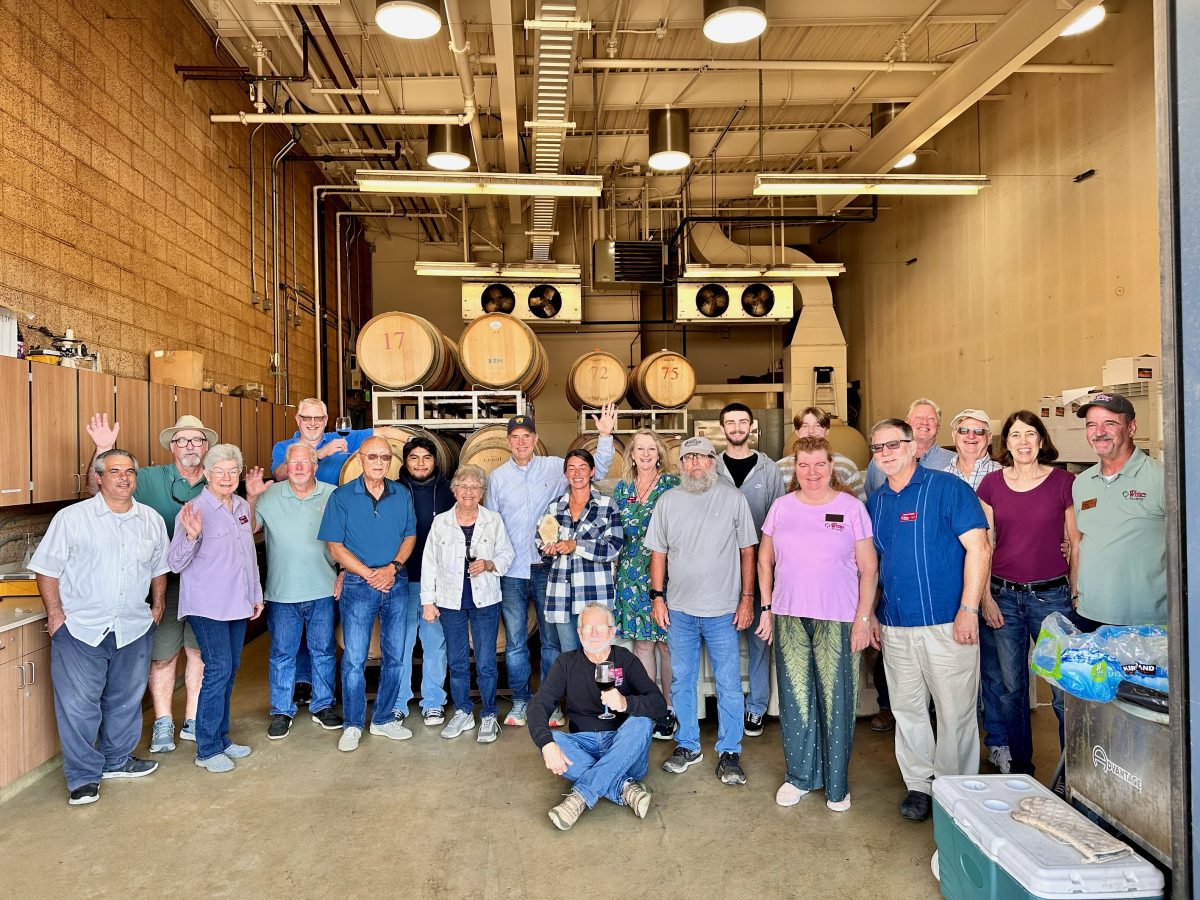
To collect personal accounts of the organization, the committee started the Vintage Member Luncheons. These events have been both successful and incredibly fun. Our ultimate goal is to produce a history of the organization’s first 50 years.

The luncheons feature various stations where longtime members can view old videos taken by our own Charley Owen, view and identify photos from early events, share their own stories with interviewers and contribute to idea boards for things like 50th anniversary events and keepsakes. All of this is designed to trigger memories of the early years.
OCWS members who have attended the Vintage Member Luncheons have had a great time sharing memories of bus trips to Temecula and Paso Robles and cruises to Mexico. Being together with other vintage members in this social setting has greatly facilitated our ability to gather information that is not documented elsewhere. Believe it or not, a few of our original members such as Jane Goodnight and Judy Brady are still active. And the memories that attendees shared made it seems like only yesterday.
Here is a taste of some of the things that were shared…
In addition to sharing memories, attendees are treated to a gourmet lunch and wine.

Invitations are being sent out based on the member’s join date. The first two luncheons included those who joined between 1976 and 2000. We are currently in the process of planning our third luncheon. If you are invited to a luncheon but unable to attend, you will be invited again until you are able to attend one.
To allow all members to attend these luncheons, we are limiting members to attending only one luncheon. Watch your email for an invitation in the future as we include more recent members.
Merchandise will be available for sale at upcoming Orange County Wine Society events. Aprons and hats (four standard colors) are always available online as they are one size fits most.
But did you know the OCWS logocan be added to other apparel?
If you don’t see a style, size or color that I’m selling, a shirt from home can be an option. The logo looks great on a fleece vest or denim jacket too! For custom apparel, there is a $15 embroidery fee. Bring your item to an event or drop it off
in the OCWS office. Merchandise also will be available at upcoming Winemakers’ Group dinners, January through May.
—Courtney, Merchandise Maven
Last month, we recognized our top volunteers at the NEW Volunteer Recognition Reception. Our hope is to make this an annual tradition.
Pre-COVID, we recognized our volunteers at the Annual Business Meeting in September. When we moved the annual meeting online, the OCWS Board recognized that this was a better format for the financial review of the organization. However, while the online format worked well for the business meeting portion, it was not the best format for recognizing volunteers. As such, we decided to hold an in-person event to celebrate our amazing volunteers who put in more than 23,000 hours between September 2023 and August 2024.
The event featured appetizers from Newport Rib Company and wine from the OCWS Cellar. Volunteers were recognized at three levels (Gold, Silver and Bronze) based on the number of hours they volunteered. In addition to being invited to the Volunteer Recognition Reception, the volunteers received printed certificates, and an online coupon good toward a future OCWS event ($50, $25 and $10, respectively). We would like to recognize the following volunteers for their many hours of service to the organization:
Volunteers that make a Difference
The afternoon soiree ended with the most coveted OCWS award, the President’s Award, given to this year’s top volunteer or volunteers who have given amazing service to the organization, not only this year, but over many years.
Thank you to the committee who made this year’s Volunteer Recognition Reception possible: Rochelle Randel, Don Mayer, Sue England and Carolyn Christian.
Congratulations to all the volunteer award winners. For those who were unable to attend the reception, your names will be posted on the OCWS website and you will see your online discount coupon in your account no later than November 1.
—Carolyn Christian, OCWS President
Ingredients:
2 Tbsp. olive oil
¼ tsp. crushed red pepper flakes
3 cloves of garlic, minced
1 pint cherry tomatoes, sliced in half
¼ cup vegetable broth (I used lemon wine)
3 Tbsp. fresh lemon juice (divided)
½ cup fresh basil, chopped
½ tsp. lemon zest
½ tsp. salt
1 tsp. sugar
¼ tsp. fresh ground pepper
11/2 lbs. fresh cod
For the sauce: heat olive oil in a large sauté pan over medium heat.
Add red pepper flakes and garlic, sauté for 1 minute. Add tomatoes and cook until soft and blistered. (9-12mins) Stir in liquid and 1 tbsp lemon juice. Simmer gently, then add basil and 2 tbsp. lemon juice, zest, salt, sugar and pepper. Cook for 2 minutes, set aside.
For the cod:
Heat olive oil in another pan over medium heat. Season cod with salt & pepper.
Cook until golden brown. About 3 minutes per side. Pour the tomato basil sauce over the cod, warm up for a minute, enjoy!
Orange County Wine Society funds scholarships for eight California colleges and universities, including the University of California Davis.
UC Davis has a dedicated Department of Viticulture and Enology that was established back in 1880 by the California Legislature to help the developing California wine industry and is considered one of the top programs in the country. In 2011, UC Davis opened a facility for making wine, beer and processed foods with sustainability and the environment in mind.
The campus hosts a four-acre vineyard next to the Robert Mondavi Institute. The department typically graduates about 20 undergraduate students in viticulture and enology per year. UC Davis also offers a Master of Science degree.
The Viticulture & Enology Graduate Group (VENGG) provides opportunities where students can conduct research on current issues in the wine industry through independent research and internships. This program graduates five to 10 students per year. The department also offer a Wine Executive Program that teaches the fundamentals of winemaking and management skills necessary to be successful in the challenging wine business world.
Next month we will be highlighting another of the colleges/universities supported by the OCWS Scholarship Fund. Just a friendly reminder there is always time to donate to the OCWS Scholarship Fund for 2024. There are two ways to donate:
—Damian Christian, Scholarship Chair
September’s Varietal Hour was all about Pinots. Well almost. Of course, the French grapes; Pinot Noir, Pinot Gris and Pinot Meunier, as well as the Italian grape, Pinot Grigio, were all discussed.
But what about the lesser known or even obsolete Pinot-X grape names? What about a Pinot grape that was bred specifically for one country or a Pinot grape that really wasn’t a Pinot grape? Test your knowledge as we go.
In 1924, at South Africa’s University of Stellenbosch a viticulture professor crossed two French varietals, one more robust with one more difficult to grow, to create a unique grape that would thrive in South Africa’s climate.
ANSWER: True. Professor Abraham Perold performed an open-air hybridization in the vineyard and not in a controlled greenhouse.
Which two French grapes did Professor Perold cross?
a) Pinot Noir and Merlot
b) Pinot Noir and Malbec
c) Pinot Noir and Cinsaut
d) Pinot Noir and Gamay Noir
ANSWER: C. Pinot Noir with Cinsaut or Cinsault, a red grape that is heat tolerant and grown predominantly in the Rhone Valley, Languedoc, Roussillon and Provence regions of Southern France.
Cinsault is one of the 13 approved grapes allowed to be used to make Chateauneuf du Pape wine.
ANSWER: True. Cinsault is a minor blending grape along with predominately Grenache, Syrah and Mourvedre for red wine in the Southern Rhone region.
The grape, a cross between Pinot Noir and Cinsault, was named PINOTAGE. Why?
a) Because Professor Perold wanted it to be a heritage grape of South Africa
b) Because an old South African name for Cinsaut was Hermitage
c) Because it took several stages to propagate
d) Because they didn’t like the name Herminoir
ANSWER: B and D. When the Cinsault grape originally arrived from France in the 1850’s it was misnamed as Hermitage. And yes, they discarded Herminoir!
Although Pinotage has failed to develop a significant presence in planted acreage, how many countries currently have Pinotage in their vineyards other than South Africa?
a) 2
b) 4
c) 6
d) 8
ANSWER: D. Eight very diverse countries are growing Pinotage: Brazil, Canada, Germany, Israel, New Zealand, Switzerland, U.S. (Arizona, California, Michigan, Oregon, Virginia and Washington) and Zimbabwe.
Every grape seems to have its day. On May 17 it’s Pinot Grigio Day; Aug. 18 is International Pinot Noir Day; and Dec. 16 is Pinot Meunier Day. Does Pinotage have a day?
a) Yes
b) No
ANSWER: Yes. International Pinotage Day is Oct. 12. Hope you didn’t miss it this year!
Now what about that obsolete Pinot grape?
In the 1880s and 1890s red French grapes were being planted in California and used to make wines sold as “Burgundy.” Pinot’s many synonyms caused a great deal of confusion when it came to naming the grapes being used to make the wine.
Which of these names were used as Pinot Noir synonyms in California vineyards?
a) Pinot Franc
b) Pinot Pernand
c) Pinot Noirien
d) Pinot St George
e) All of the above
ANSWER: E. Although three of these grape names are for true Pinot Noir Clones, one turned out later not to be a Pinot Noir Clone.
In 1997, it was determined through DNA testing that a California grape, believed to be a Pinot Noir clone was actually a grape from southwestern France, known as Negrette. In the same year the Bureau of Alcohol, Tobacco and Firearms (BATF) ruled that Negrette could no longer be called by what name?
a) Pinot France
b) Pinot Pernand
c) Pinot Noirien
d) Pinot St George
ANSWER: D. The name Pinot St George was originally used because it was believed that the grape came from the Nuits-St-George region of Burgundy.
The Negrette grape, although very rare, is from the French region of Frontonnais near Toulouse. Its origin is not known and genetic studies have not been able to determine a source, but legend has it that it was brought to France from the Near East by the Knights Templar.
a) True
b) False
c) Perhaps
ANSWER: C. Who knows? It’s a legend!
Negrette is rare not only in France but also California. But a few acres of Negrette can be found in which California county?
a) San Luis Obispo
b) Monterey
c) San Benito
d) Santa Cruz
ANSWER: C. The only two wineries I could find that make a Negrette wine are both in San Benito County—Stirm Wine Co. and DeRose Winery.
If it’s a Pinot cross, bred for a country or a Pinot that isn’t a Pinot, don’t get confused. No matter what it’s called, when you find one you like just open it and enjoy! Cheers!
—CL Keedy, Wine Education Committee
When Tom and Laureen Baldyga moved into their Cowan Heights home in 2011, they had a set of priorities: a house with a view, a three-car garage and a wine cellar.
While the home had sweeping views of Orange County and Catalina Island as well as the three-car garage that would accommodate practice sessions for Tom’s band, the couple had to find the space for the cellar.
They finally settled on a 6×6 spot underneath the stairs. The couple got some of their inspiration from Bacchus Secret Cellars in Irvine where Laureen once worked. After working with a contractor on the design and its features, the cellar was built and has become a centerpiece of the Baldyga home.
The outside of the cellar is adorned with about 30 wine case panels emblazoned with the logo and name of wineries from around the world that the Baldygas have gotten from Bacchus or collected themselves.
Some of the panels that are represented by some of the most renowned wineries such as Caymus, Silverado, Opus One and Screaming Eagle, are separated by rows of corks. The cellar’s door has bunches of grapes etched onto the glass.
At just 36 square feet, the cellar holds 300 bottles and has enough room to seat two people. A majority of the wine is from Duckhorn and Calcareous vineyards where the couple are wine club members.
“We like to store the Duckhorn for about five years and then drink it,” Tom said. “Both wineries are extremely consistent with what they make and Calcareous produces excellent Syrahs and have great whites like Viognier and Sauvignon Blanc.”
The cellar also has a glass rack and two storage spots for wine accessories. One of those spots is a nook with a marble top. On the back wall is a painting entitled “Perfect Zen” by popular artist Michael Godard.
Like any good cellar, the couple ensured it was temperature controlled and would hold enough wine to make it worth their while.
“I’d recommend finding a place that has drainage built in,” Tom said. “Try to know someone who can do the design. It’s amazing what you can do with a small space.”
Tom said the cellar does serve the main purpose of storing the wine but he and Laureen also make sure they enjoy the wine with family and friends. His prized possessions are a 1994 Harlan Estate Cabernet Sauvignon and a 2011 Perry Moore Cab.
“I don’t think I would change a thing,” Tom said. “I like that it’s not too big so it’s always full. But part of the fun is drinking the wine and refilling the cellar.”