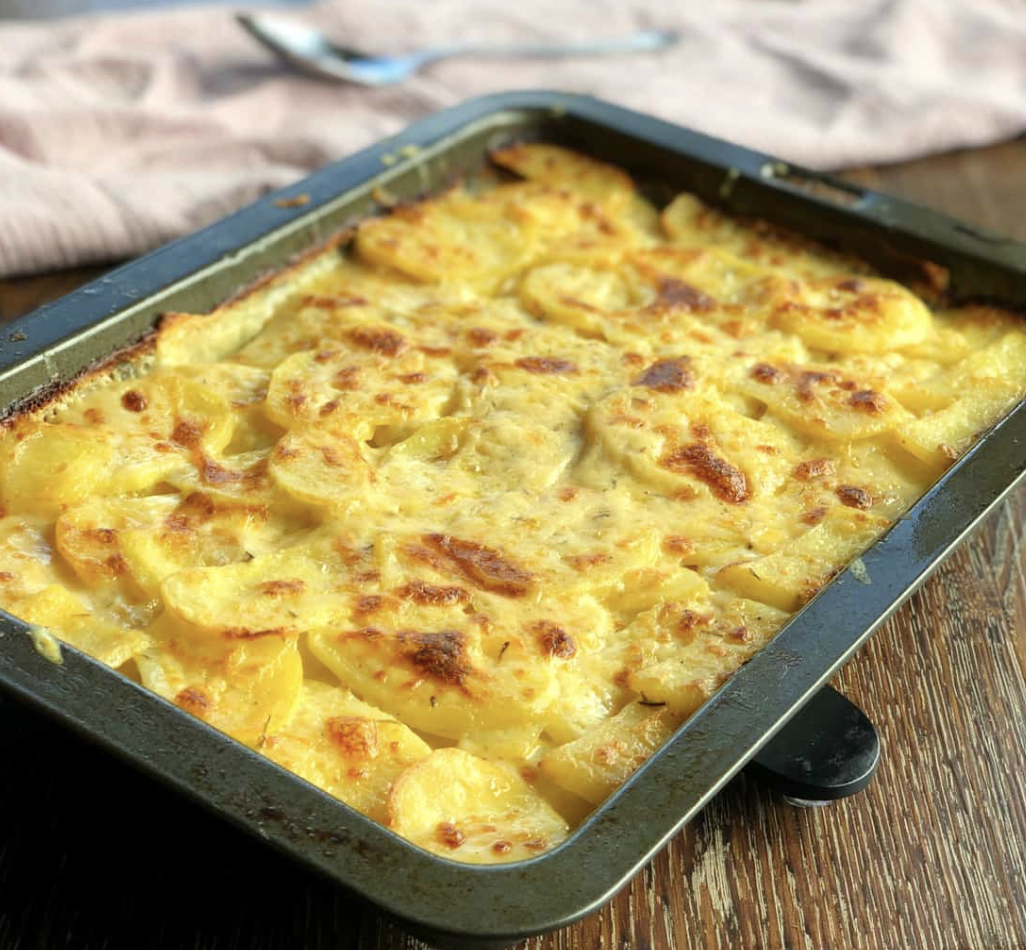
4-5 medium to large russet potatoes, peeled & sliced into ¼ inch slices
12 oz cheddar cheese, shredded (including 6 oz aged cheddar)
12 oz whole milk
12 oz heavy whipping cream
1/8 tsp nutmeg
Salt & ground pepper
Preheat the oven to 375 degrees F
Use one garlic clove to rub over the bottom and sides of a 8 X 13 or 9 X 14 glass casserole dish then use 1 Tbsp of butter to grease the dish.
In a medium saucepan, lightly whip the milk, cream and nutmeg. Add the remaining garlic clove. Bring to a full boil, then remove from the heat and set aside.
Arrange potato slices in a single, slightly over-lapping layer, lightly sprinkle with salt and pepper, then add some of the cheese. Repeat until there are a total of three potato & cheese layers.
Pour the sauce through a large fine mesh strainer into the casserole dish. Sprinkle the remaining cheese over the top and dot with the remaining butter. Lightly cover with foil and bake for 45 minutes. Remove the foil and bake for an additional 10-15 minutes uncovered until the top is nicely browned. Serves 9-12
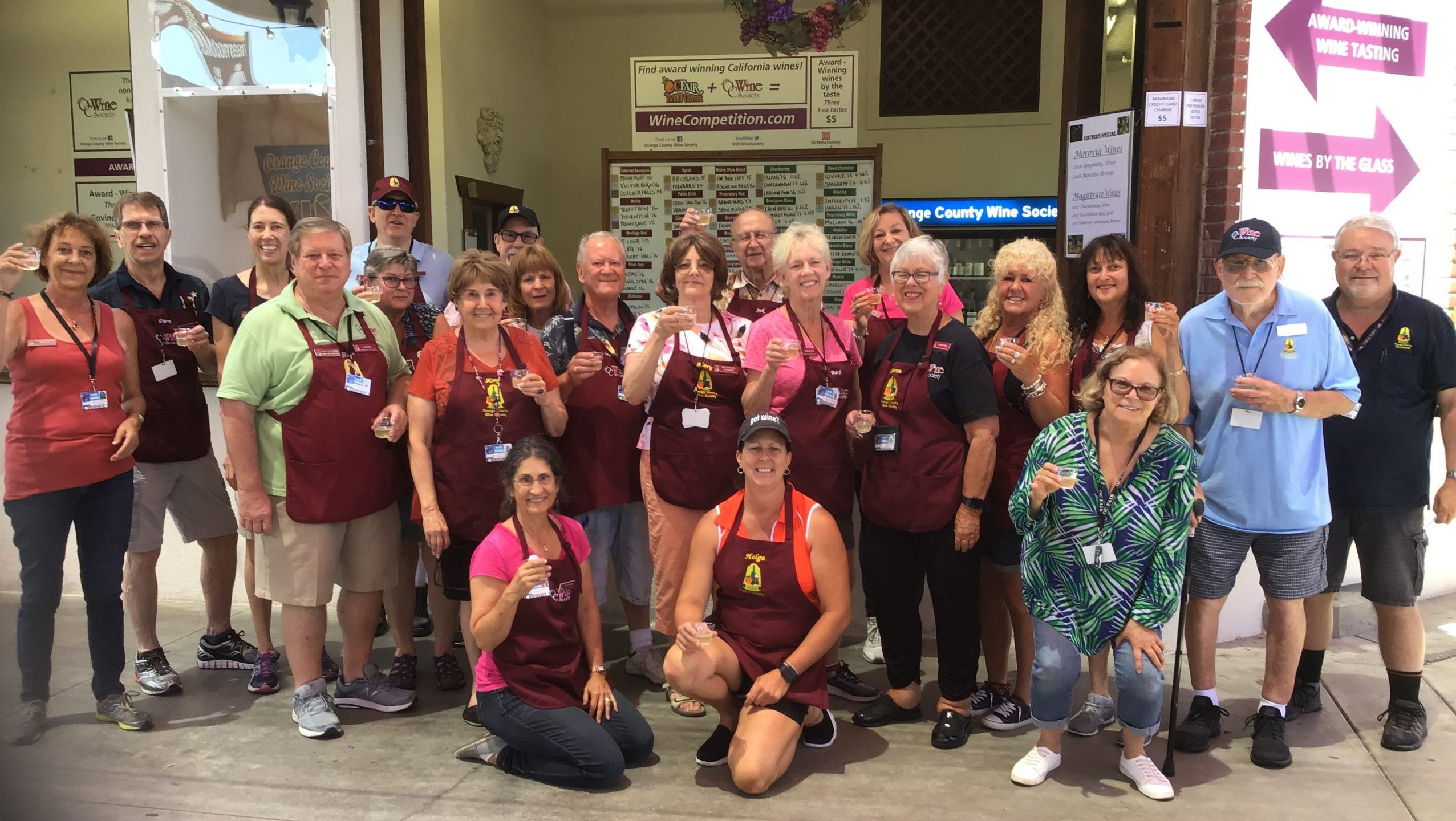
March is here and we are getting ready for the series of sign-ups for The Courtyard. Volunteering to help is an exciting opportunity to meet members, learn about different wines and enjoy the OC Fair.
Cashiers will be able to sit throughout their shift. Stewards work involves standing to carry ice and/or move several bottles of wine up to a heavy case during their shift.
Signing up for the fair will be opened in several phases. All members are required to sign up for a minimum of four shifts. Selecting more shifts is recommended if you a shift you selected was full and closed. Other things to know:
1. RBS Certification is required before signing up for The Courtyard.
2. Manager sign-ups open April 1 at 8 a.m.
3. Cashier and Steward sign-ups open April 15 at 8 a.m.
4. Server sign-ups open May 1 at 8 a.m.
5. All Courtyard sign-ups close on the OCWS website May 31.
6. Shifts will be confirmed in late June or early July. We will do our best to assign members to their selected shifts; however, some members may be asked to work different shifts if needed.
We will have five daily shifts during the 23 days of The Courtyard, Wednesdays through Sundays, July 17 through Aug. 16. The sooner you sign up for your shifts, the greater the opportunity to get the shifts you want. The times of these shifts will be:
10 a.m. to 1 p.m.
1 to 4 p.m.
4 to 8 p.m.
8 to 10:30 p.m. (Wed., Thurs., Sun.)
8 to 11:30 p.m. (Fri., Sat.)
Express Bar: 5 to 9 p.m.
Note: The Courtyard closes one hour before the fair closes.
In recent years, the OC Fair has limited daily attendance to a maximum number of guests. One of the benefits of volunteering at The Courtyard is guaranteed fair entry on your volunteer days—and even on days you just want to enjoy the fair—with parking included.
Courtyard Sign-Up Conditions:
There is a known limitation with Courtyard shift sign-ups on our website when multiple members submit their selections at the same time. When the first person “Submits” their choices, other members are not notified that those shifts may no longer be available. All selected shifts are still recorded in the system, and Courtyard management will review submissions and try to resolve any conflicts.
Working with another member – Most members sign up together with their spouse or significant other as Dual Members. If you would like to work the same shift as someone else:
because you and your spouse or significant other are not Dual Members together, especially if you have different last names or
you would like to work the same shift with a friend—please explain in the Comments block at the bottom of the website sign-up page. Signing up early before shifts fill up is helpful.
Before we know it, the OC Fair will be upon us again. The largest OCWS fundraising effort of the year will be taking place for a total of 23 days, Wednesdays through Sundays, July 17 through Aug. 16.
Volunteering at The Courtyard is a unique and fun experience. All Courtyard volunteers handling wine in any capacity are required to be RBS (Responsible Beverage Server) certified through the ABC (Alcohol Beverage Commission) pursuant to fair requirements. RBS certification is required prior to signing up as a volunteer.
It is highly recommended that new members obtain RBS certification as soon as possible, so they are prepared when volunteer sign-ups open. This also applies to those renewing this year. All OCWS volunteers serving as managers, stewards, or servers must be RBS certified. Volunteers who serve exclusively as cashiers are not required to be certified; however, obtaining RBS certification allows access to a wider range of volunteer opportunities.
EMAIL US – To get started, just email Sue England at RBS@ocws.org and let her know you need RBS certification this year.
THREE-STEP PROCESS – More detailed instructions will be sent to you when you register.
1. Create an RBS account with Alcoholic Beverage Control (ABC).
2. Take the online, self-paced course through the RBS provider that OCWS has selected.
3. Take a final quiz with ABC online and obtain the ABC certification, which is valid for three years. You are now ready to serve in the courtyard at the OC Fair.
PLEASE NOTE – Each OCWS member will need a valid individual email address that will be used to set up your account. Your own individual email address will be your username for the online system. Thank you so much for your volunteer efforts. You are what makes the OCWS the great success it is.
Maybe I am showing my age. No, I am definitely showing my age by using Jackie Gleason’s famous line as the title of a Wine Wisdom about mead. Mead, the product of yeast turning a honey and water mixture into alcohol. A natural fermentation that, as a result of archaeologic discoveries, may have first occurred among African bush tribes some 20,000-40,000 years ago. Exactly when mead was first created is obviously hard to determine, but humans’ desire for alcoholic beverages, even sweet alcoholic beverages, has perpetuated the making and consuming of mead a reality, from then till now. And OCWS’ Varietal Hour on Tuesday, March 3 will continue that reality as the focus that evening will be on mead.
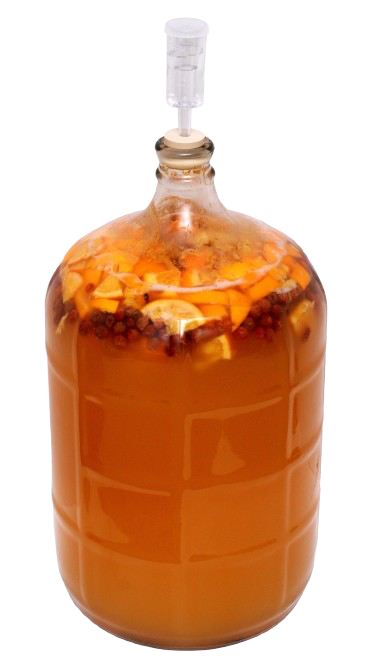
Making mead is relatively easy. And many have done it and are still doing it. Today’s basic recipe is adding three pounds of honey to one gallon of water and add yeast. However, the origin of honey wine is thought to have been an accident, although a happy one. Wild honey accidentally blending with rainwater and then fermented by natural yeast, produced a honey wine. Evidence has been found that 7,000 years ago Northern Chinese pottery held such a fermented drink. The Greeks and Romans called it “Nectar of the Gods” believing it to be a divine drink with medicinal benefits. The Vikings called it “Mead of Poetry” that provided wisdom and poetic stimulation to whomever partook. Mead has been referenced in ancient writings of the Celts and Anglo-Saxons (epic poem Beowulf), in the Finish Epic: The Kalevala and in Welsh texts: The Book of Taliesin and The Gododdin, as well as the sacred books of India’s religions (the Rigveda). The ancient Greeks considered Bacchus the God of Mead before he was updated to the God of Wine. Mead is mentioned over the years in writings from Chaucer’s Canterbury Tales, to J. R.R. Tolkien’s Lord of the Rings, to George R. R. Martin’s A Song of Ice and Fire series (aka HBO’s Game of Thrones). This honey of a drink has even been credited with the coining of the word Honeymoon as a result of the ancient tradition of giving newlyweds enough mead to last them a moon’s cycle to boost fertility.
As I said above, many are making mead. The list of countries where mead can be found is too long for this article. And if it hadn’t been for beer and wine a lot more of it would be commercially made today. But it appears that rarely are two recipes the same. For example, in Finland it’s made with brown sugar and raisins; while in Ethiopia they flavor it with powdered gesho, a bittering agent; and in the Philippines galanga root, a local herb with ginger, citrus and pine flavors, is fermented with the honey. It also appears that there is almost anything that can be added to differentiate the local meads, i.e, maple syrup, blueberries, burned honey, elderberries, coffee, apples, herbs, nutmeg, cinnamon, and even grapes to confuse its heritage, each of these blends having their own unique name. In fact, the first time I judged the OCWS Home Winemakers Competition the panel I was on judged various meads including a chocolate mead. But is mead always sweet? Not in the least. And as important as sweetness levels are in determining diverse wine styles the same is true for mead, which can be made dry, semi-sweet and sweet relying of course on the honey must and particular yeast employed. Likewise, current meadmakers can make stylistic choices of either still or sparkling mead, with alcohol by volume (ABV) ranging from 3.5% to 20.5%. Mead can also be distilled to a brandy or liqueur alcohol strength. Finally, if you freeze fermented mead and remove the frozen water, a process known as “freeze distillation”, the resulting product is known as Honey Jack which will result in a potion with a higher ABV.
Now I have a favor to ask. As mentioned above, on March 3, there is a scheduled OCWS Varietal Hour with mead as the topic. You can get your free ticket on the OCWS website’s Events section, then pick up a bottle of mead at your favorite liquor store and join us to find out just how sweet it is!