Sideways in Santa Barbara
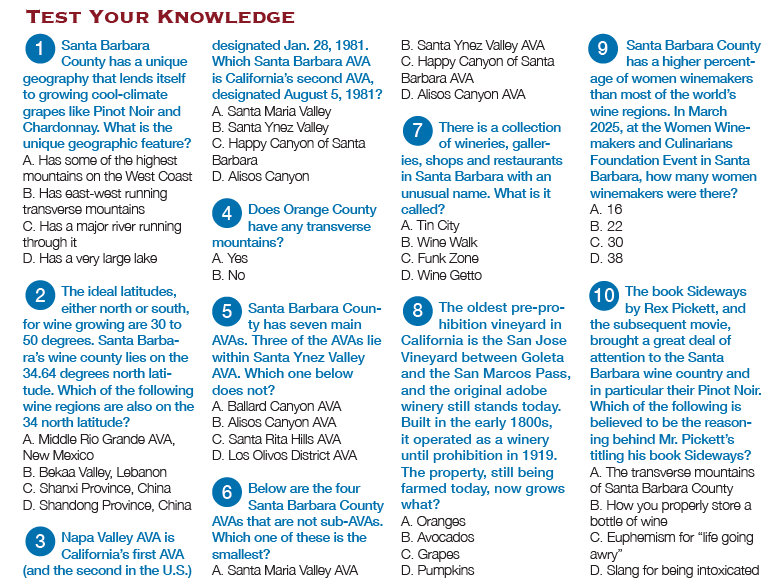
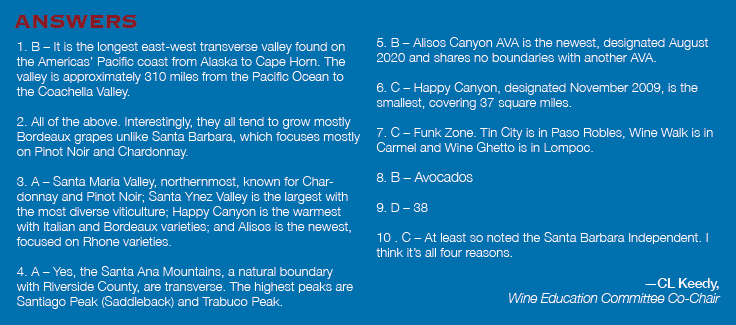
Santa Barbara, sideways? Well, I guess it is! Santa Barbara is unique wine country with its creation beginning around 4 million years ago when the north to south running San Andreas fault turned left. Even prior to this, around 23 million years ago the northwest-southwest mountains started to rotate clockwise which still continues today. The western mountain ranges rotated about 90 degrees while the eastern mountain ranges rotated about 40 degrees creating an unusual, long west-east valley. (As an aside, Catalina Island rotated the most, 120 degrees.)
This twisting and turning of mountains, creating the Transverse Mountain Ranges that extend from west of Point Conception eastward for more than 300 miles into the Mojave and Colorado deserts, opens the region up to the direct influence of the Pacific Ocean. A climate effect that most other California wine regions do not experience. This geographic structure creates a cool, foggy tunnel that provides the ideal climate for cool weather grapes such as Pinot Noir and Chardonnay. The morning fog, replaced in the afternoon by the warmth of the sun and an ocean breeze, begins its return in the late afternoon. This produces an advantageous climate cycle slowing grape ripening. The western coolness of the valley warms significantly as you move eastward changing the climate and subsequently the grapes that can be grown.
During the same geologic period of continental plate collisions and tectonics 20 million years ago, the ocean floor uplifted leaving behind a highly diverse soil. Santa Barbara’s transverse valley’s soil, composed of calcareous limestone from ancient marine shells and skeletons, diatomaceous earth resulting from the fine powder of fossilized marine life, and sandy soils and clay loams, can respectively provide wine grapes with acidity, concentration, fruitiness and earth with the necessary moisture retention.
However, winemakers did not take advantage of this ideal climate until the late 18th century, when the Franciscan monks planted their grape cuttings from Mexico near the Santa Barbara Mission. By 1804 a large, 25-acre mission vineyard was planted in today’s Goleta. And by the late 1800s there were 45 vineyards in the region including a 150-acre vineyard on Santa Cruz Island. Even though the oldest pre-prohibition vineyard in California was planted in Santa Barbara, prohibition slowed vineyard expansion in Santa Barbara until Santa Barbara’s first post-prohibition commercial winery was stared in 1962, the Santa Barbara Winery.
Today there are almost 300 wineries in the seven American Viticultural Area (AVAs) in Santa Barbara County that grow over 70 grape varieties including from French Bordeaux and Rhone grapes to Italian and German grapes, even though it is best known for Pinot Noir and Chardonnay.